





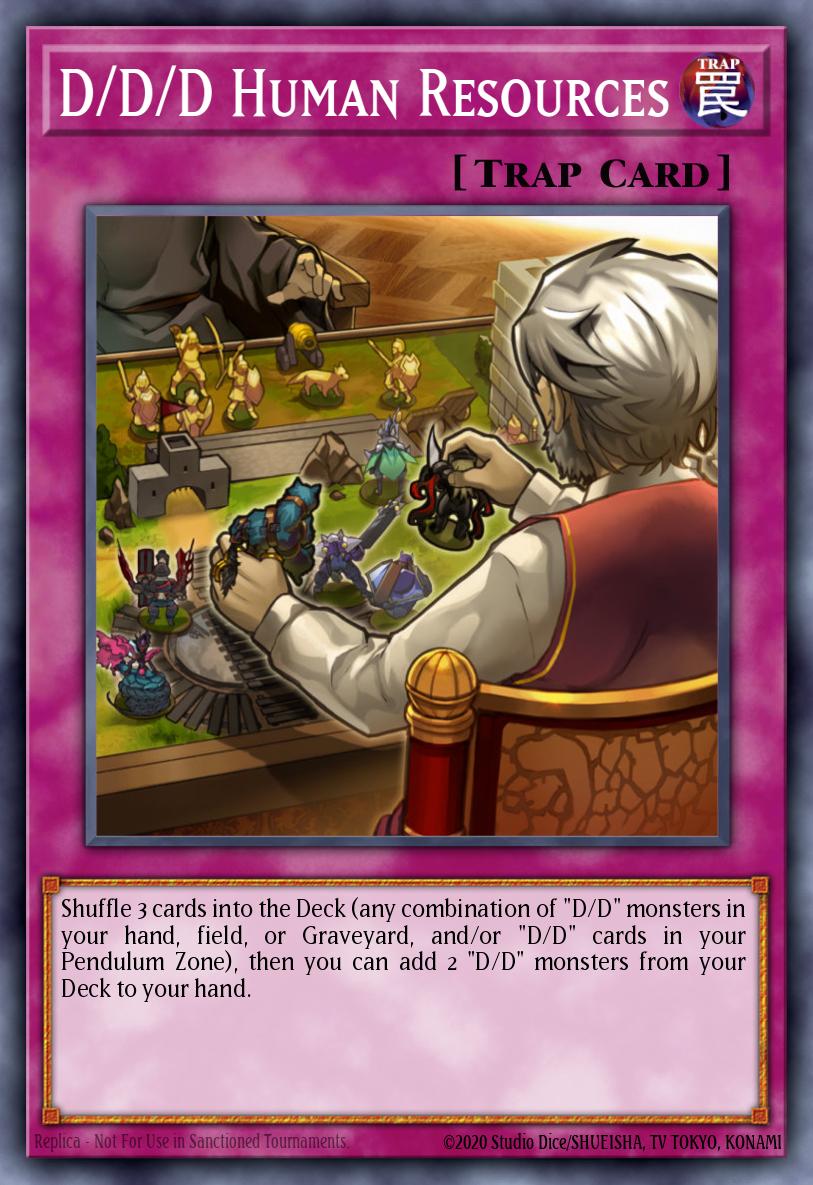

 Trap
 Normal
D/D/D Human Resources
Archetype:
D/D
View:
4013
Shuffle 3 cards into the Deck (any combination of "D/D" monsters in your hand, field, or Graveyard, and/or "D/D" cards in your Pendulum Zone), then you can add 2 "D/D" monsters from your Deck to your hand.
D/D/D Human Resources — Power Evaluation
Final Score: 47 ± 8 · Confidence: Medium
- Intrinsic: 44 · Deck: 49 · Meta: provisional
- Primary role: Searcher/Tutor · Secondary: Recovery/Recursion
Why it scores here
D/D/D Human Resources converts three D/D resources (hand, field, GY, or Pendulum Zone) into a search for two D/D monsters, a net -1 card trade that recycles dead cards into the Deck. It is a trap with no opponent interaction, and its effect is archetype-locked to D/D, so the high deck count (58 decks, 13 archetype tags, 1.16 average copies) confirms it is a reliable, cheap tutor inside D/D lines rather than a strong card in general. No combo data was supplied, so the starter and payoff contribution is text-only and held to a moderate score.
Axis scores
| Axis | Score | Evidence |
|---|---|---|
| Accessibility | 55 | The card is live only after being set a turn, but D/D lines feed it readily and it is run in 58 decks (starter role unavailable, no combo data) (observed+inferred). |
| Combo & Conversion | 40 | Two monsters for three shuffled resources is a body-generating search, but no combo boards were supplied to confirm a one-card-to-board line (inferred). |
| Resource Economy | 35 | Net -1 card in hand, offset only by shuffling GY and field D/D cards back into the Deck for recursion, with no measured netCardAdvantage (verified text, inferred net). |
| Effect & Interaction | 5 | The text has no negate, removal, or disruption against the opponent, so this axis is near zero (verified). |
| Material Utility | 10 | The card is a trap and does not itself serve as material; its only body value is the two monsters it searches (verified text, inferred). |
| Resilience & Flexibility | 30 | A set trap is exposed to generic negation during its activation chain, and the text offers no redundancy beyond the copy count (inferred). |
| Deck-Building Efficiency | 60 | It runs at 1 to 2 copies (avg 1.16 across 58 decks) with no garnet or lock restriction, so it is cheap to run (observed). |
Calculation
Weight profile: 0.7 Searcher/Tutor + 0.3 Recovery/Recursion. Intrinsic ≈ 44, Deck ≈ 49, Meta = provisional. Modifiers: none. Final formula: 0.40*Intrinsic + 0.60*Deck
Strengths
- Cheap, low-copy tutor that searches two D/D monsters
- Recycles GY and field D/D cards into the Deck
- Heavily co-played with the core D/D engine (96.6% with Dark Contract with the Gate)
- Easy to run, with no garnet or lock restriction
Weaknesses
- Trap timing: it must be set, so it is slow compared with quick effects
- Net -1 card advantage in hand
- Archetype-locked to D/D, with no value in other archetypes
- No opponent interaction and no board presence
Counters / choke points
- Generic negation of the activation chain (no specific counter cards named in the evidence)
Best use
Searcher/Tutor with GY-recycling support in D/D lines. Decks: D/D/D, D/D/D (D.D.), D/D.
Evidence & gaps
- Verified: Effect: shuffle 3 D/D cards from hand, field, GY, or Pendulum Zone into the Deck, then optionally add 2 D/D monsters from the Deck to hand; Archetype is D/D; 58 decks run it at 1.16 average copies, 49 of them at one copy; Top partner co-occurrence: Dark Contract with the Gate 96.6%, Dark Contract with the Swamp King 93.1%
- Observed: 36.2% of decks are in the D/D/D archetype tag and 20.7% in D/D/D (D.D.); Runs in 3 gameplay types, 39.7%, 32.8%, and 27.6% of decks; Recency spans 2022-10 to 2026-08, so the card is still actively played
- Inferred: Normal Trap timing (frame is trap, no Quick-Play, Continuous, or Counter text), so it must be set a turn before use; Net -1 card in hand, offset only by recycling GY and field cards into the Deck; Interaction risk is limited to generic negation of the activation chain
- Data gaps: no combos supplied, so combo conversion is text-only inference no guides supplied no banlist token, so 3 copies (unlimited) is assumed no usage statistics (StatisticsCard), so archetype inclusion % comes from the deck sample only Normal Trap timing is inferred from the frame type, not stated in text